
I'm Fesify, and in this piece I want to walk you through the last days and the wider story that led to Amy Winehouse's tragic death. I produced a short documentary exploring the three days before she passed and, as someone who has followed and reported on music history for years, I felt it was important to lay out the facts, the context, and the human details that the headlines too often miss.
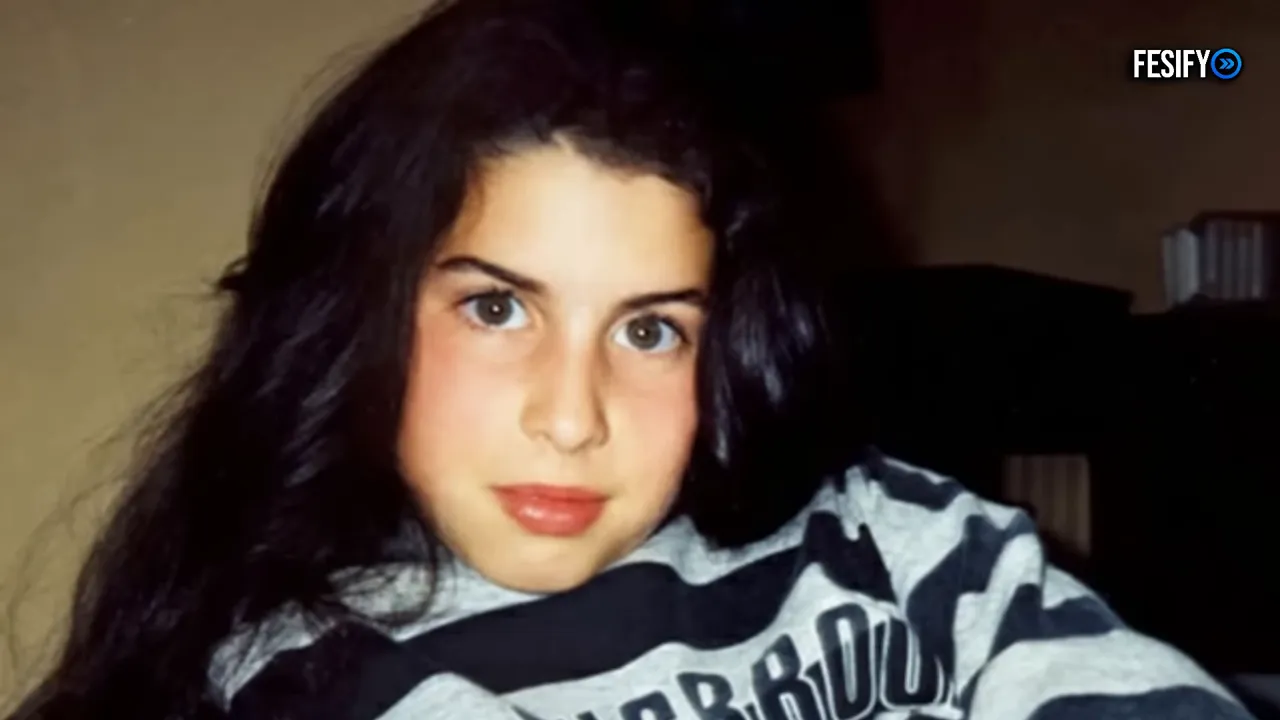
Why we keep coming back to Amy's story
Amy Winehouse was an artist of towering talent who captured the world's attention long before she became a cautionary tale. Her debut album Frank (2003) announced a singular voice; Back to Black (2006) turned that voice into international legend and earned five Grammy Awards. Yet alongside the music there was a darker pattern: public struggles with alcohol, drugs, and eating disorders that became as much a part of the narrative as her songs.
In telling this story I aim to balance celebration and tragedy. Amy's music endures — you will still hear her singing across the globe — but understanding what happened to her matters, not to sensationalise but to remember, to learn, and to honour her properly.
Early promise and sudden exposure
Amy Jane Winehouse was born on September 14, 1983, in London to Mitch and Janice Winehouse. From an early age she made clear she wanted music to be her life. She said she hoped to "still be singing when I'm 80" and that she wanted people to remember her work. That earnest ambition would collide with an era of increasingly aggressive celebrity media.

When Amy first spoke in interviews about fame, she sounded disarmingly grounded: "I'm not a star. I'm not even famous in my country," she said. But fame found her regardless, and the relationship between a fragile, self-aware artist and the new breed of relentless paparazzi proved poisonous. Photographers chased every stumble, every excess, and those images fed a market that profited from shame.
The spiral: addiction, relationships, and health
Amy's public problems were not only the media's doing. From the mid-2000s her substance use became increasingly visible. An overdose in August 2007 required hospitalization, and her marriage to Blake Fielder-Civil only amplified the turmoil. Their relationship was intense, high on emotional extremes and low on stability. Both used drugs and the public incidents that followed — arrests, court appearances, admitted use — painted a stark picture of codependency.

Compounding her struggles was bulimia, an eating disorder that Amy battled from her teens. Bulimia doesn't just affect weight and appearance; it causes electrolyte imbalances, weakens organ systems, and can significantly alter how the body processes toxins such as alcohol. Her brother later suggested this made her more vulnerable to alcohol's effects.
Amy's own words: depression and self-awareness
"I do drink a lot. I think it's symptomatic of my depression. Like I'm a manic depressive... I'm not an alcoholic, which sounds like an alcoholic in denial."
That quote captures Amy's complex relationship with addiction. She was candid and self-aware — often cuttingly so — but that awareness did not translate into consistent recovery. Interviews show someone who understood the danger but simultaneously minimised it, dismissed formal structures, or stumbled under the logistical realities of treatment (fears about leaving home, feeding pets, the sense that rehab was a PR exercise).

Rehab attempts and the limits of intervention
Amy's road through rehab and treatment was messy and intensely personal. At times friends and management tried to force her into treatment, at other times she resisted. One anecdote sums up that ambivalence: she once joked that her cats "saved" her from going into a residential programme because of her concern about who would look after them. That sense of everyday logistics mingled with deep denial.
Her father Mitch admitted he may have been in denial to an extent — "maybe I am to a certain extent but it's my way of coping," he said — and the management's sometimes distant attitude (some accounts say they were in a pub while she faced the prospect of treatment) further complicates questions of responsibility. In short: the people around her often loved her, but their actions sometimes fell short of what she needed.
The attempted comeback and the warning signs
By 2011 Amy was attempting a major comeback. She had been preparing for a European tour, was optimistic about new material, and friends said she seemed focused and even excited about the future. But the return to the public eye exposed how fragile that recovery still was.

Her performance in Belgrade on June 18, 2011, was a public collapse. Visibly intoxicated, she failed to perform properly, forgot lyrics, and was booed off stage. The show ended her comeback tour and crystallised a painful reality: when addiction impairs your ability to work — and when the world is watching — the consequences are immediate and brutal.
Moments of joy and normalcy
Even amid the collapse there were moments that remind us Amy was more than tabloid headlines. One of her last public appearances, dancing with her goddaughter at the iTunes Festival in London, shows someone who could still laugh, move, and enchant. Footage from that night, only three days before her death, reveals a woman who could appear happy and engaged — a reminder that addiction often masks itself behind outward cheer.

The breakup, loneliness, and relapse
Amy's divorce from Blake in 2009 was a turning point emotionally. Their relationship had produced intense highs and devastating lows; when it ended she faced profound loneliness. Later relationships, including one with Reg Traviss, offered moments of stability but not the steady support that sustained recovery requires. Reg later said they had plans and felt optimistic in the weeks before she died — a cruel irony in hindsight.
"We were looking forward to it, and I just remember thinking, after that, everything's going to be, you know, we're really... everything felt good." — Reg Traviss
Despite those moments of hope Amy relapsed. From the timeline we assembled, the crucial few days in July 2011 show a rapid descent — two weeks of sobriety, then a return to heavy drinking, and finally her death on July 23.
Timeline of the final days (July 20–23, 2011)
Below is a reconstructed timeline, based on witness accounts, medical reporting, and family testimony. It focuses on the immediate events that preceded Amy's passing.
- July 20–22: After approximately two weeks of sobriety Amy resumes drinking heavily. The lapse in tolerance after abstaining for weeks is crucial — it dramatically increases the danger of consuming amounts of alcohol that would previously have been manageable.
- July 22: A doctor visits and finds Amy tipsy but calm. She admits to a relapse and says, "I don't want to die," but is uncertain about quitting for good. Reports indicate she refused psychological therapy.
- Evening, July 22: Amy spends time with her mother Janice. They exchange "I love you"s. Later she watches videos of her performances with her bodyguard, Andrew Morris, until around 2am and comments on her vocal talent.
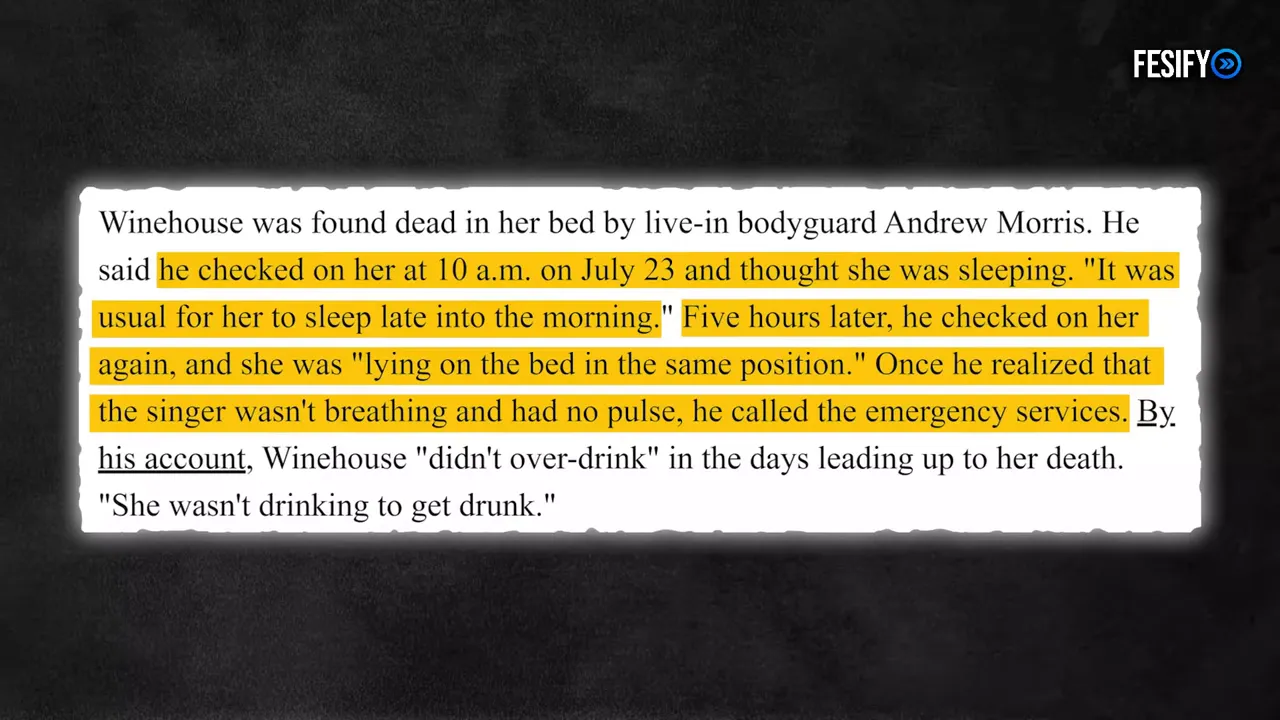
- Morning, July 23: Amy tells her security team she's going to sleep. Morris checks on her around 10am and assumes she is resting.
- Afternoon, July 23 (approx. 14:30–15:00): Morris checks again and finds her unresponsive. Emergency services arrive and Amy is pronounced dead at her Camden home. She is found in bed with a laptop and three empty vodka bottles (two large, one small) nearby; initial toxicology finds no illegal drugs but a high concentration of alcohol.
The inquest and the medical facts
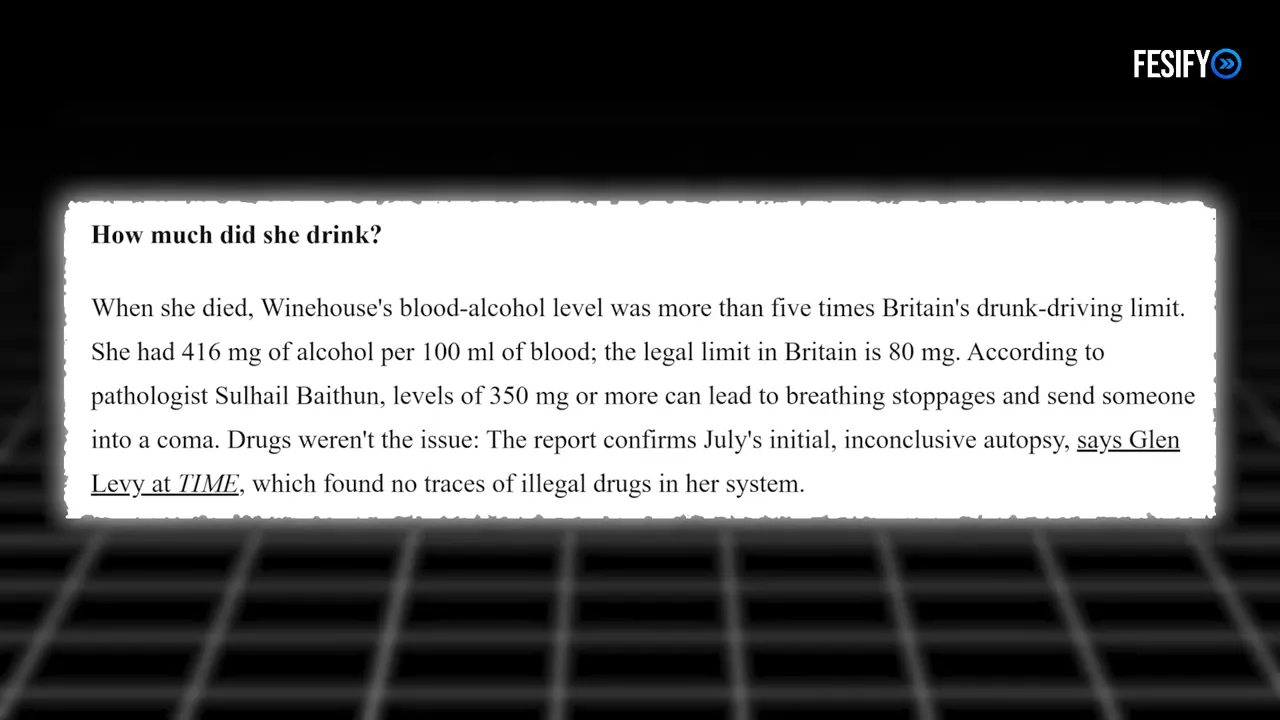
The coroner's ruling was unequivocal: Amy's death was a misadventure due to alcohol poisoning. The toxicology report recorded an alcohol concentration of 416 milligrams per 100 millilitres — roughly five times the UK driving limit of 80. Levels above approximately 350 mg/100 ml are considered potentially fatal. A prescribed sedative intended for alcohol withdrawal was present but was judged not to have contributed to the death.
"You can't have a specific level that will kill a particular individual. We're all different... The other thing that makes a difference is whether you're in training. If you drink a lot regularly, you're more likely to get away with it. Now, Amy had stopped drinking three weeks prior to her death, and so that tolerance would have gone down." — Coroner's explanation
That point about "training" — the body's tolerance to alcohol — is central to understanding many alcohol-related deaths. If someone has been a heavy drinker and then stops, the liver and nervous system rapidly lose the biochemical adaptations that allow them to tolerate large amounts. A binge after a period of abstinence can therefore be far more dangerous than the same intake when "in training."
Why bulimia and medical history matter
Amy's family, friends, and later media investigations highlighted another contributing factor: her long history of bulimia. Bulimia causes repeated bouts of vomiting, dehydration, and electrolyte imbalance. Over time, it can weaken the cardiovascular system and liver function and, importantly, can alter how alcohol is processed. Amy's brother Alex pointed to this as one reason she may have been more susceptible to alcohol poisoning than someone without such an eating disorder.
In short, several elements converged — a high measured blood alcohol concentration, a body weakened by years of eating disorder and substance use, and a loss of tolerance after a period of sobriety. The coroner concluded that this combination resulted in accidental alcohol poisoning.
Aftermath: legacy, accountability, and the foundation
Amy's death prompted grief and furious debate. Fans demanded answers; critics asked who had a duty of care. Blake Fielder-Civil has faced enduring criticism from some quarters; he has acknowledged responsibility but also argued he is unfairly singled out. Management and the media have also been scrutinised for how they handled and — perhaps more importantly — exploited Amy's struggles.
In a positive response, Amy's family established the Amy Winehouse Foundation to help young people facing addiction and mental health issues. The foundation channels a legacy of care and awareness into active support programs — a tangible outcome aimed at preventing future tragedies.

Her life and death also inspired cultural examinations: the 2015 documentary Amy offered an intimate and controversial portrait, and the 2024 film Back to Black revisited her life from a dramatized perspective. These works contributed to a fuller public conversation about addiction, fame, and how we as a society treat vulnerable artists.
Lessons from Amy's story
Amy Winehouse's death is not a single-factor tragedy; it was the result of many things aligning in the worst possible way. A few takeaways stand out:
- Tolerance is not safety: Stopping drinking doesn't instantly remove risk — a return to prior drinking levels after abstinence can be lethal.
- Mental health matters: Amy repeatedly described her drinking as symptomatic of her depression; treating addiction in isolation from mental health is incomplete.
- Support systems must be substantive: Love and intention are not the same as the clinical and logistical support someone in addiction needs. Well-meaning friends can be overwhelmed; institutions and carers require clear responsibility and follow-through.
- Media ethics matter: The paparazzi's relentless pursuit did not cause addiction, but the ecosystem that rewards images of people at their worst creates industry incentives that harm vulnerable people.
Remembering Amy beyond the headlines
Amy Winehouse's music remains the clearest, sharpest record of who she was as an artist: raw, emotionally honest, and timeless. Songs like "Back to Black" and "Rehab" document feelings and experiences that were real and urgent for her. Many artists have made huge cultural contributions at tragically young ages; Amy is among those whose work continues to move people decades on.

As someone who made a film about these events and as someone who has followed stories like hers, I hope readers take away two things: first, the importance of treating addiction with empathy and rigor; second, the need to keep the focus on Amy's art as well as her pain. Good music lives forever — and with careful remembering, so can lessons that might save lives.
Final thoughts
Every time we retell Amy Winehouse's story we risk repeating the same errors that surround celebrity and suffering: sensationalism, blame, and simplification. My aim has been to present the facts clearly, include Amy's own voice where possible, and trace the human threads that led to July 23, 2011.
Her death was ruled accidental alcohol poisoning. It was the result of a series of missteps, medical vulnerabilities, and tragic timing. But it should not be reduced to a single explanation. Amy was a brilliant singer and songwriter, a complicated human being, and someone whose life and death still teach us about the complexities of addiction, fame, and care.
If you or someone you know is struggling with addiction or mental health issues, please seek professional help. There are organisations and services designed to provide immediate support and long-term care — asking for help can make a life-saving difference.
Credits and invitation
If you found this piece informative, please seek out more resources on addiction and the Amy Winehouse Foundation for ways to contribute or to learn more about prevention and support.